

On October 4–5, 2025, actuarial educators and researchers gathered in New Orleans, Louisiana, for the Special Session on Actuarial Mathematics and Actuarial Education at the American Mathematical Society (AMS) Fall Southeastern Sectional Meeting. This gathering marked the first AMS special session dedicated to actuarial topics since 2021. Over a day and a half of presentations, speakers explored emerging challenges, evolving models, innovative pedagogy and new collaborative directions for the future of actuarial science.
What follows is an overview of the program’s structure, key themes and collaborative outcomes that emerged during this session.
Planning an Inclusive Forum for Actuarial Collaboration
The authors of this article organized the special session with the goal of creating an interactive forum where educators and researchers could exchange ideas, share concerns and explore emerging opportunities. While larger actuarial conferences—such as the Actuarial Research Conference (ARC) or the Actuarial Teaching Conference (ATC)—offer valuable engagement, the AMS setting provides several unique advantages:
- A smaller, more diverse audience encourages deeper discussion and cross-institutional collaboration.
- A convenient US location offers accessibility for those unable to attend ARC (Canada) or ATC (Indonesia) in 2025.
- Integration within a mathematical sciences meeting helps strengthen ties between actuarial science and related fields.
After submitting the proposal in February 2025 and receiving AMS approval the following month, we invited a diverse slate of participants, including representatives from the Society of Actuaries (SOA), program directors, senior faculty, early-career researchers and practitioners. Seventeen speakers ultimately joined the session, making it the largest actuarial-focused AMS meeting to date.
During the summer, we collected presentation topics and developed a program with three thematic sessions:
- The Future of Actuarial Education
- Applications of Actuarial Methods
- Advanced Actuarial Models
Presentations were held on the campus of Tulane University, where attendees enjoyed lively conversation, networking and intellectual exchange.
The Future of Actuarial Education
The opening session focused on challenges and opportunities shaping actuarial education, especially in an era of rapid technological change.
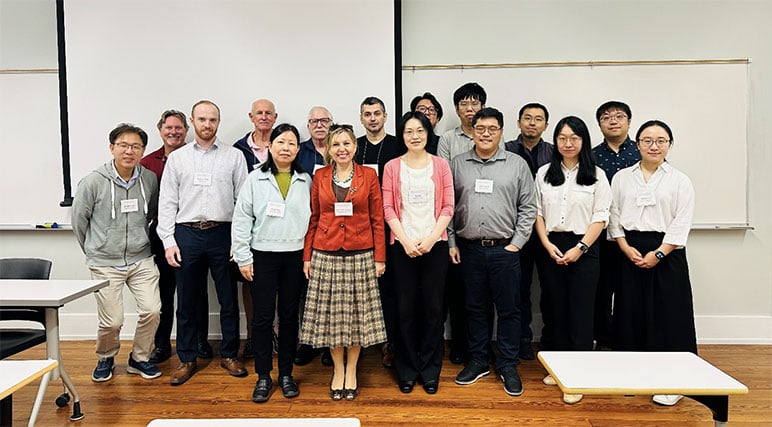
Figure 1
Presenters and Staff Day 1
Artificial Intelligence and the Evolving Role of Educators
The session began with Jiacheng Cai from Salisbury University, who examined the implications of generative artificial intelligence (AI) for actuarial education. He outlined three levels of AI and explored how different stakeholders—students, faculty, employers and professional societies—perceive its benefits and risks.
He also highlighted opportunities such as enhanced learning support and improved efficiency but also cautioned against overreliance, hallucinations, widening preparation gaps and resource constraints. Ultimately, Cai emphasized that strong communication and collaboration across stakeholder groups will be essential for integrating AI responsibly and effectively.
Experiential Learning Through Case-Based Activities
Next, Fang Yang from Georgia State University presented her innovative case study on survivorship universal life (SUL) modeling. This project requires students to construct mortality assumptions, work with industry-standard data sources and apply actuarial formulas to a realistic policy scenario.
The case is designed to strengthen technical proficiency in Excel, improve conceptual understanding and promote experiential learning. Yang shared implementation strategies, the project structure and student learning outcomes, illustrating how hands-on activities can bridge classroom theory with actuarial practice.
Using AI to Scale Competency-Based Assessments
Building on the AI theme, Stefanos Orfanos from Georgia State University discussed whether artificial intelligence could help convert comprehensive actuarial case studies into scalable, competency-based assessments. Using SOA case competition materials as examples, he demonstrated how iterative prompt engineering can generate tasks aligned with the SOA’s eight professional competencies.
While early results show strong potential for generating tasks that assess technical and communication skills, challenges remain when evaluating soft skills. Orfanos stressed the need for future research to validate AI-assisted assessment tools with real learners.
Industry-Sponsored Research Projects for Graduate Students
Ian Duncan from University of California Santa Barbara (UCSB) described a graduate-level actuarial research course at the university in which students collaborate with industry partners on real-world research problems.
Running over 20 weeks and enrolling about 18 students annually, the course emphasizes scientific writing, data analysis, R and Excel programming, and professional presentations. Projects culminate in posters at UCSB’s Undergraduate Research Colloquium, and many are later presented at the Actuarial Research Conference, where they have earned awards. This partnership model benefits both students and sponsoring companies.
Challenges and Resources for Actuarial Educators
Stephen Paris from Florida State University highlighted structural challenges faced by actuarial faculty, including resource shortages, alignment of courses with professional requirements and recognition barriers. He also discussed the benefits and trade-offs of the University Exam Credit (UEC) program and introduced Actuarial Educators, an organization supporting high-quality instruction across institutions.
SOA Perspectives and Open Discussion
Closing the education-focused session, Stuart Klugman from the Society of Actuaries presented resources and programs the SOA offers to support educators. He also addressed audience questions about assessment design, case study development and AI usage. Klugman encouraged continued communication within the actuarial education community and reaffirmed the SOA’s commitment to partnership.
Applications of Actuarial Methods
The second segment of the program focused on practical applications of actuarial techniques to real-world problems.
Modeling Persistent Mortality Shocks
Kenneth Zhou from University of Waterloo introduced a new stochastic mortality model addressing the lingering effects of cause-specific mortality shocks, such as those from the COVID-19 pandemic.
Traditional models often assume mortality shocks are short-lived, but empirical data show persistent, heterogeneous impacts. Using conditional maximum likelihood estimation, Zhou’s team identified long-term patterns across demographic groups and demonstrated potential implications for insurers’ tail risk management and scenario testing.
Understanding FEMA Disaster Relief Allocation
Pei Pei from Otterbein University presented her group’s exploration of FEMA’s Individual Housing Program (IHP) post-disaster grants following the 2024 Ohio tornadoes. Using FEMA and census data, her team created an interactive dashboard to analyze eligibility and grant amounts.
They applied generalized linear models (GLMs) to examine how demographic, structural and community-level variables influence aid outcomes. Their findings support more transparent, data-driven evaluation of disaster relief policies—an area of increasing importance to actuaries working in catastrophe modeling and public sector risk.
Queuing Systems and Practical Applications
Natalia Humphreys from University of Texas at Dallas provided an accessible and comprehensive overview of queuing systems (QS) as birth-and-death stochastic processes widely used in telecommunications, insurance, computer systems and traffic modeling.
She discussed limiting behaviors, system characteristics, and the thinning process for Poisson models. Her applied examples illustrated the versatility of QS in managing capacity constraints, customer wait times and operational efficiency.
Healthy Life Expectancy and Retirement Wellness
Yingzhou He from University of Central Missouri presented research on Healthy Life Expectancy (HLE) and the novel Golden Years Life Expectancy (GYLE) metric. These models incorporate risk factors such as diet and exercise, combined with baseline mortality data, to estimate expected years of healthy living.
He also introduced a personalized health tracking tool that provides weekly guidance—an application with potential relevance for insurers interested in wellness-focused products.
Poisson-Tweedie Reserving in Value-Based Health Care
Sooie-Hoe Loke from Middle Tennessee State University discussed a Poisson-Tweedie collective reserving model tailored to value-based health care contracts. These contracts, including gain-sharing arrangements, increasingly influence US health care spending.
Applying the model to real health care data, the team illustrated how insurers can estimate reserves for both value-based and fee-for-service components of provider payments.
Flood Risk Education Through Teaching Case Studies
Sungwon Ahn from Roosevelt University presented a teaching case study exploring flood risk in real estate portfolios. The case introduces a flood-adjusted property valuation (FAPV) model and integrates probabilistic risk modeling with loan-to-value (LTV) analysis.
This resource helps students and instructors better understand how climate-related risks affect property valuation and portfolio management—a growing concern for insurers and financial institutions.
Advanced Actuarial Models
The final session showcased advanced modeling research across various actuarial domains.
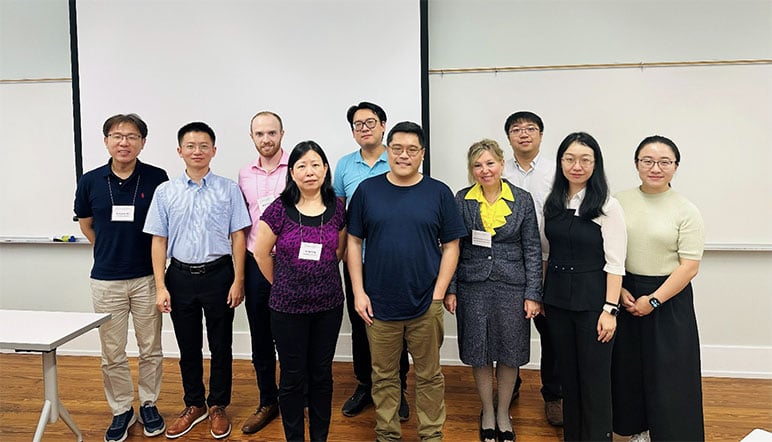
Figure 2
Presenters and Staff Day 2
Optimal Insurance with Prevention Efforts
Evan Cribbie from York University examined continuous-time optimal insurance models in which the insured can undertake risk-reduction activities that lower claim severity. Using a mean-variance framework, the team derived semi-explicit solutions for optimal insurance design and optimal prevention effort and analyzed their interplay through numerical testing.
Reducing Basis Risk in Hedging Variable Annuity Guarantees
Wenchu Li from St. John's University introduced a data analytic approach to mitigate basis risk in variable annuity (VA) portfolios. Using diversified portfolios and historical fund returns, the algorithm achieved low residual basis risk and low transaction costs while relying on only a small set of hedging instruments.
Extreme Gini Functionals for Tail Risk Assessment
Xing Wang from Illinois State University (ISU) proposed new methodologies for measuring tail variability in extreme risk scenarios using extensions of Gini functionals. The ISU team developed nonparametric estimators, studied asymptotic behavior and introduced new coefficients for assessing systemic and marginal tail risks—all supported by real data analysis.
Automated Machine Learning (AutoML) for Insurance
Zhiyu Quan from University of Illinois Urbana-Champaign presented an AutoML framework designed for actuarial and insurance applications. The workflow automates preprocessing, model selection and hyperparameter tuning, while addressing common challenges like class imbalance.
The tool enables users with minimal ML experience to implement competitive models using only a few lines of code, with full documentation available on GitHub.
Federated Learning for Secure Predictive Modeling
Closing the session, Lu Xiong from Middle Tennessee State University introduced a secure actuarial data collaboration engine funded by the Casualty Actuarial Society (CAS). Using federated learning, zero-knowledge proofs and encryption techniques, the platform allows institutions to collaboratively train models without sharing raw data.
Results show similar predictive accuracy to centralized models while significantly reducing privacy risks—an important advancement for data-constrained actuarial research.
Looking Ahead: Building a Collaborative Actuarial Future
Across all sessions, a clear theme emerged: actuarial science is at a pivotal moment, shaped by technological advances, societal shifts and evolving professional needs.
Speakers emphasized the importance of the following:
- Responsible integration of generative AI
- Experiential and case-based learning
- Innovative modeling for emerging risks
- Interdisciplinary engagement
- Stronger collaboration among educators, researchers and practitioners
The success of this AMS special session highlights the value of small, inclusive forums that bridge gaps between academia and industry. Participants expressed enthusiasm for continuing this momentum through joint research projects, shared teaching resources and future meetings that deepen collaboration across the actuarial community.
This article is provided for informational and educational purposes only. Neither the Society of Actuaries nor the respective authors’ employers make any endorsement, representation or guarantee with regard to any content, and disclaim any liability in connection with the use or misuse of any information provided herein. This article should not be construed as professional or financial advice. Statements of fact and opinions expressed herein are those of the individual authors and are not necessarily those of the Society of Actuaries or the respective authors’ employers.
Jiacheng Cai, Ph.D., is an associate professor and the Actuarial Science program coordinator in the Department of Mathematical Sciences at Salisbury University. Jiacheng can be reached at jxcai@salisbury.edu.
Fang Yang, Ph.D., ASA, is a clinical associate professor and the director of the undergraduate Actuarial Science program at the Maurice R. Greenberg School of Risk Science at Georgia State University. Fang can be reached at fyang10@gsu.edu.